

Hey there! As a supplier of titanium alloy spring washers, I often get asked about the heat treatment process for these nifty little components. So, I thought I'd take a moment to break it down for you in a way that's easy to understand.
First off, let's talk about why heat treatment is so important for titanium alloy spring washers. Titanium alloys are known for their high strength, low density, and excellent corrosion resistance. But to really unlock their full potential and make them suitable for use in spring washers, we need to give them a proper heat treatment. This process helps to improve the mechanical properties of the titanium alloy, such as its hardness, toughness, and elasticity.
The heat treatment of titanium alloy spring washers typically involves several key steps. The first step is heating. We heat the titanium alloy spring washers to a specific temperature, usually within a range that's carefully determined based on the type of titanium alloy being used. For many common titanium alloys, the heating temperature can be anywhere from 700°C to 1000°C.
Why this temperature range? Well, different titanium alloys have different phase transformation temperatures. By heating the alloy to the appropriate temperature, we can cause the atoms within the alloy to rearrange themselves in a way that changes the alloy's microstructure. This is crucial because the microstructure of the titanium alloy directly affects its mechanical properties.
Once the titanium alloy spring washers have reached the desired heating temperature, we need to hold them at that temperature for a certain period of time. This is called the soaking time. The soaking time allows the heat to penetrate evenly throughout the washers and ensures that the phase transformation occurs uniformly. The length of the soaking time depends on factors such as the size and thickness of the spring washers, as well as the specific titanium alloy.
After the soaking time is up, the next crucial step is cooling. The cooling rate is extremely important as it can have a significant impact on the final properties of the titanium alloy spring washers. There are different cooling methods we can use, such as air cooling, oil quenching, or water quenching.
Air cooling is a relatively slow cooling method. It allows the titanium alloy to cool gradually, which can result in a more stable and less brittle microstructure. This is often a good option for titanium alloy spring washers that require high toughness.
Oil quenching, on the other hand, is a much faster cooling method. It involves immersing the heated spring washers in oil. The rapid cooling rate helps to lock in the desired phase transformation and can significantly increase the hardness of the titanium alloy. However, oil quenching also increases the risk of cracking and residual stress in the washers.
Water quenching is the fastest cooling method. It's similar to oil quenching but uses water instead. This method can produce the highest hardness in the titanium alloy, but it also has the highest risk of cracking and distortion. So, we usually reserve water quenching for applications where extreme hardness is required and the risk can be managed.
In addition to the basic heating, soaking, and cooling steps, sometimes we also perform additional heat treatment processes such as annealing or aging. Annealing is a process where we heat the titanium alloy spring washers to a relatively low temperature and then cool them slowly. This helps to relieve internal stresses in the washers and improve their ductility.
Aging, on the other hand, is a process where we heat the titanium alloy to a specific temperature after quenching and hold it there for a certain period. This can further increase the strength and hardness of the alloy through a process called precipitation hardening.
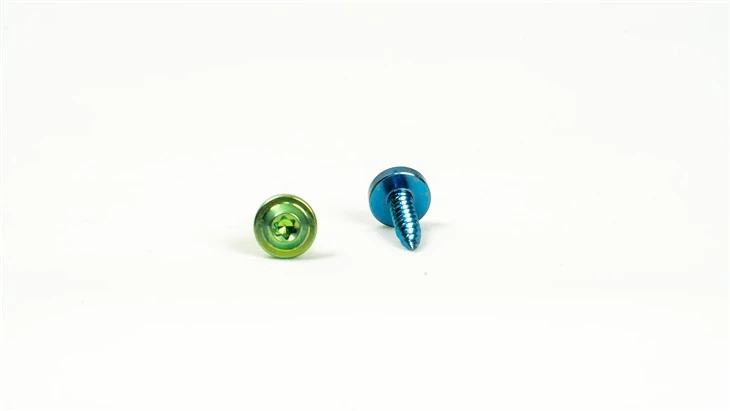

Now, let's take a look at some practical considerations when heat - treating titanium alloy spring washers. One of the big challenges is controlling the atmosphere during the heat treatment process. Titanium is a very reactive metal, and it can easily react with oxygen, nitrogen, and hydrogen in the air at high temperatures. These reactions can lead to the formation of brittle surface layers on the spring washers, which can reduce their performance and durability.
To prevent these reactions, we usually heat treat titanium alloy spring washers in a controlled atmosphere, such as a vacuum or an inert gas environment. A vacuum furnace is often used to create a low - pressure environment where there is very little oxygen or other reactive gases. Inert gases like argon can also be used to surround the spring washers during heat treatment, creating a protective shield that prevents unwanted reactions.
Another important consideration is the precision of temperature control. The heat treatment process is very sensitive to temperature variations. Even a small deviation from the desired temperature can have a significant impact on the final properties of the titanium alloy spring washers. That's why we use advanced temperature control systems in our furnaces to ensure that the temperature remains stable throughout the heating, soaking, and cooling processes.
So, that's a general overview of how titanium alloy spring washers are heat - treated. As a supplier, we take a lot of care in each step of the heat treatment process to ensure that our spring washers meet the highest quality standards.
If you're in the market for high - quality titanium alloy spring washers, or if you're interested in Self tapping titanium screws, Titanium alloy self tapping screws m5, or Flange Head Cap Bolts Titanium GR5 M10 X 50, don't hesitate to reach out. We're always happy to discuss your specific needs and provide you with the best solutions. Whether you're working on a small DIY project or a large - scale industrial application, we've got the products and expertise to support you.
References
- "Titanium Alloys: Fundamentals and Applications" by David E. Alexander and David L. Anton
- "Heat Treatment Principles and Techniques" by George E. Totten and Lindsay C. West
- Journal articles on titanium alloy heat treatment published in "Metallurgical and Materials Transactions"
