

As a supplier of M12 titanium flange surface nuts, the question of whether these nuts have good formability is one that I'm frequently asked. In this blog post, I'll delve into the topic, examining the factors that affect the formability of M12 titanium flange surface nuts, and providing some insights based on my experience in the industry.
Understanding Formability
Formability refers to the ability of a material to undergo plastic deformation without cracking or fracturing. In the context of M12 titanium flange surface nuts, good formability means that the nuts can be shaped into the desired form during the manufacturing process, whether it's through forging, machining, or other forming methods. There are several key factors that influence the formability of titanium nuts:
1. Material Properties
Titanium is known for its high strength - to - weight ratio, corrosion resistance, and biocompatibility. However, its formability can be affected by its alloy composition. For instance, the most commonly used titanium alloy for nuts is Ti - 6Al - 4V (GR5), which contains 6% aluminum and 4% vanadium. The presence of these alloying elements can significantly influence the mechanical properties and thus the formability of the material. GR5 titanium alloy has good overall formability, but it is still more challenging to form compared to some common metals like steel due to its relatively low ductility at room temperature.
2. Temperature
Temperature plays a crucial role in the formability of titanium. At room temperature, titanium has limited formability because of its hexagonal closed - packed (HCP) crystal structure. However, as the temperature increases, the crystal structure of titanium changes to a body - centered cubic (BCC) structure, which provides more slip systems and increases its ductility. Therefore, warm or hot forming processes are often used to improve the formability of M12 titanium flange surface nuts. For example, hot forging at temperatures between 800 - 950°C can make it easier to shape the nuts into the required flange and thread forms.
3. Strain Rate
The strain rate, which is the rate at which deformation occurs, also impacts the formability of titanium. At high strain rates, titanium may experience adiabatic heating, which can lead to localized softening and potentially cause cracking. On the other hand, very low strain rates may result in time - dependent deformation mechanisms such as creep, which can also affect the final quality of the formed nuts. Therefore, an optimal strain rate needs to be selected during the forming process to ensure good formability.
Formability of M12 Titanium Flange Surface Nuts
In general, M12 titanium flange surface nuts can have relatively good formability when the appropriate manufacturing processes and conditions are applied.
When it comes to the flange part of the nut, the formability allows for the creation of a well - defined and smooth flange surface. This is important as the flange provides a larger bearing surface, which helps distribute the load evenly when the nut is tightened. Through proper hot forging techniques, the flange can be shaped into the desired diameter and thickness without significant defects.
For the threading of the M12 nuts, formability is also a critical factor. The threads need to be precisely formed to ensure a proper fit with the corresponding bolts. Cold forming or machining processes can be used to create the threads. Cold forming, when done under the right conditions, can enhance the strength and surface finish of the threads. However, it requires careful control of the material's formability to avoid cracking or thread damage. Machining, on the other hand, may be more suitable for achieving high - precision threads, especially when dealing with titanium's relatively low formability at room temperature.
Manufacturing Processes and Formability
Forging
Forging is a common manufacturing process for M12 titanium flange surface nuts. As mentioned earlier, hot forging offers better formability compared to cold forging. During hot forging, the titanium material is heated to an appropriate temperature range, making it more malleable. The heated titanium billet is then placed into a die and subjected to compressive forces to shape it into the nut form. This process can produce nuts with good mechanical properties and a relatively high degree of dimensional accuracy.
Machining
Machining processes such as turning, milling, and threading are often used to refine the shape and dimensions of M12 titanium flange surface nuts. While machining does not rely as much on the material's formability as forging does, it still needs to take into account the material's properties. Titanium's high strength and low thermal conductivity can cause issues such as tool wear and heat - affected zones. Therefore, special cutting tools and machining parameters need to be used to ensure a smooth machining process and high - quality finished nuts.
Application - Related Considerations
The formability of M12 titanium flange surface nuts also has implications for their applications. In industries such as aerospace, automotive, and medical, where high - performance fasteners are required, the ability to form the nuts into the required shape is essential.
In aerospace applications, the nuts need to withstand high loads and extreme environmental conditions. The well - formed flange and threads ensure a secure connection, which is crucial for the safety and reliability of the aircraft. Similarly, in the automotive industry, especially in high - performance vehicles, titanium nuts are used for their lightweight and corrosion - resistant properties. The good formability of these nuts allows for the precise manufacturing required to meet the strict performance standards of these applications. In the medical field, such as in orthopedic implants, the formability of titanium nuts ensures that they can be customized to fit specific anatomical requirements.
Comparing with Other Similar Products
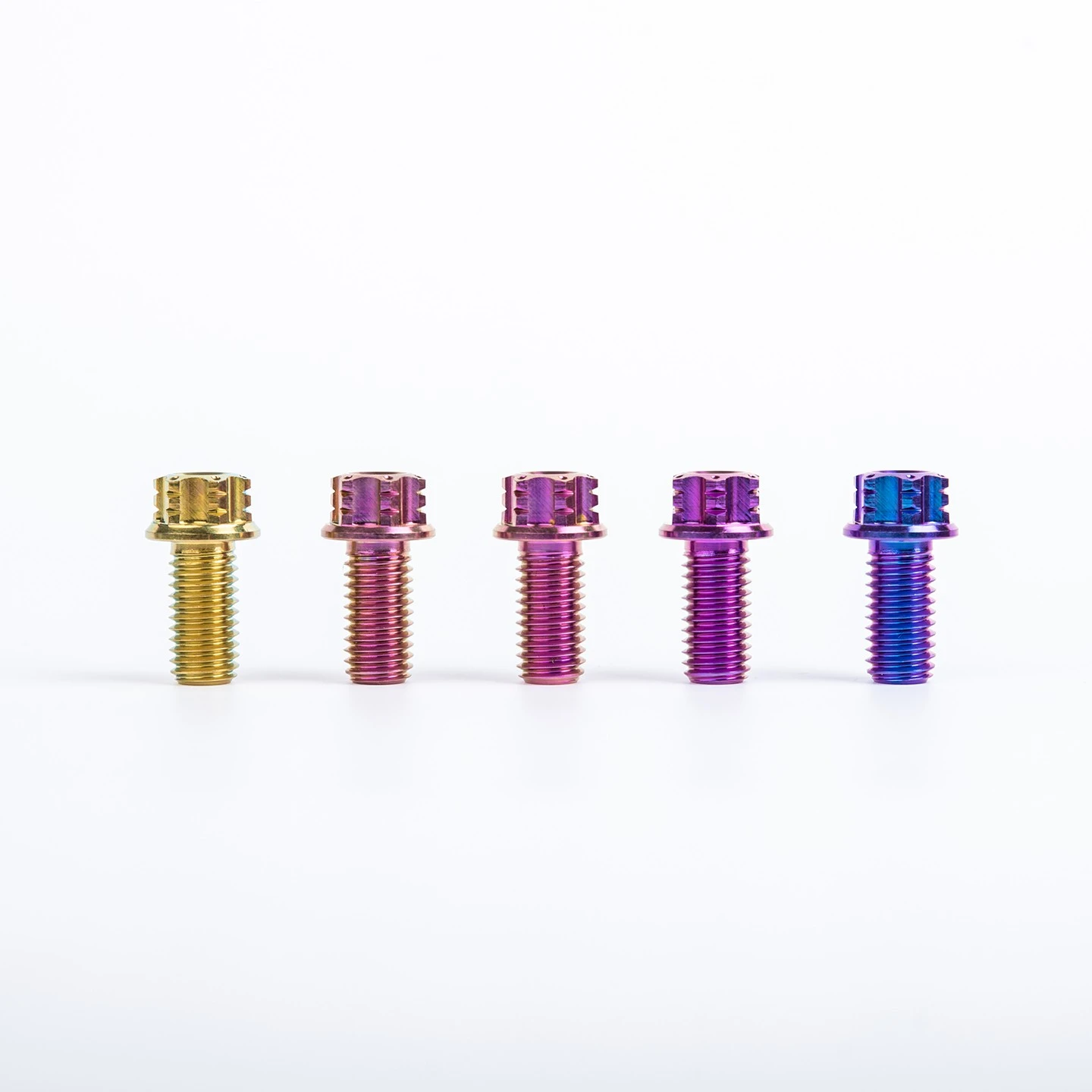
When compared to other similar products like GR5 Titanium Alloy Hex Bolts, Titanium caliper pins, and Flange Head Cap Bolts Titanium GR5 M10 X 20, M12 titanium flange surface nuts have their unique formability characteristics.
GR5 Titanium Alloy Hex Bolts typically have a more straightforward shape compared to the flange surface nuts. The formability challenges mainly lie in creating a precise hexagonal head and well - defined threads. Since the bolts do not have a flange, the pressure and force distribution during the forming process are different from those of the flange nuts.
Titanium caliper pins have a relatively simple cylindrical shape. Their formability requirements are mainly focused on achieving the desired diameter and length with a smooth surface finish. The forming processes for caliper pins may be less complex compared to those for the M12 flange nuts, which require the formation of both the flange and the threads.
Flange Head Cap Bolts Titanium GR5 M10 X 20 are similar to M12 titanium flange surface nuts in that they both have a flange. However, the different dimensions (M10 vs M12) can lead to variations in the formability requirements. Smaller - sized fasteners may require more precise control during the forming process to ensure the accuracy of the flange and thread dimensions.

Conclusion
In conclusion, M12 titanium flange surface nuts can have good formability when the right manufacturing processes, temperature conditions, and strain rates are employed. The formability is influenced by the material properties of titanium, especially its alloy composition, as well as external factors such as temperature and strain rate. Through proper forging and machining techniques, high - quality M12 titanium flange surface nuts can be produced, meeting the strict requirements of various industries.
If you are in need of high - quality M12 titanium flange surface nuts or other related titanium fasteners, I invite you to engage with me for procurement discussions. I'm more than happy to provide detailed product information, samples, and competitive pricing to meet your specific needs.
References
- "Titanium Alloys: Science and Technology" by J. C. Williams and E. W. Boyer
- "Metal Forming Handbook: Processes and Applications" by Georg Dieter, David A. Semiatin, and Robert L. Mahan
